













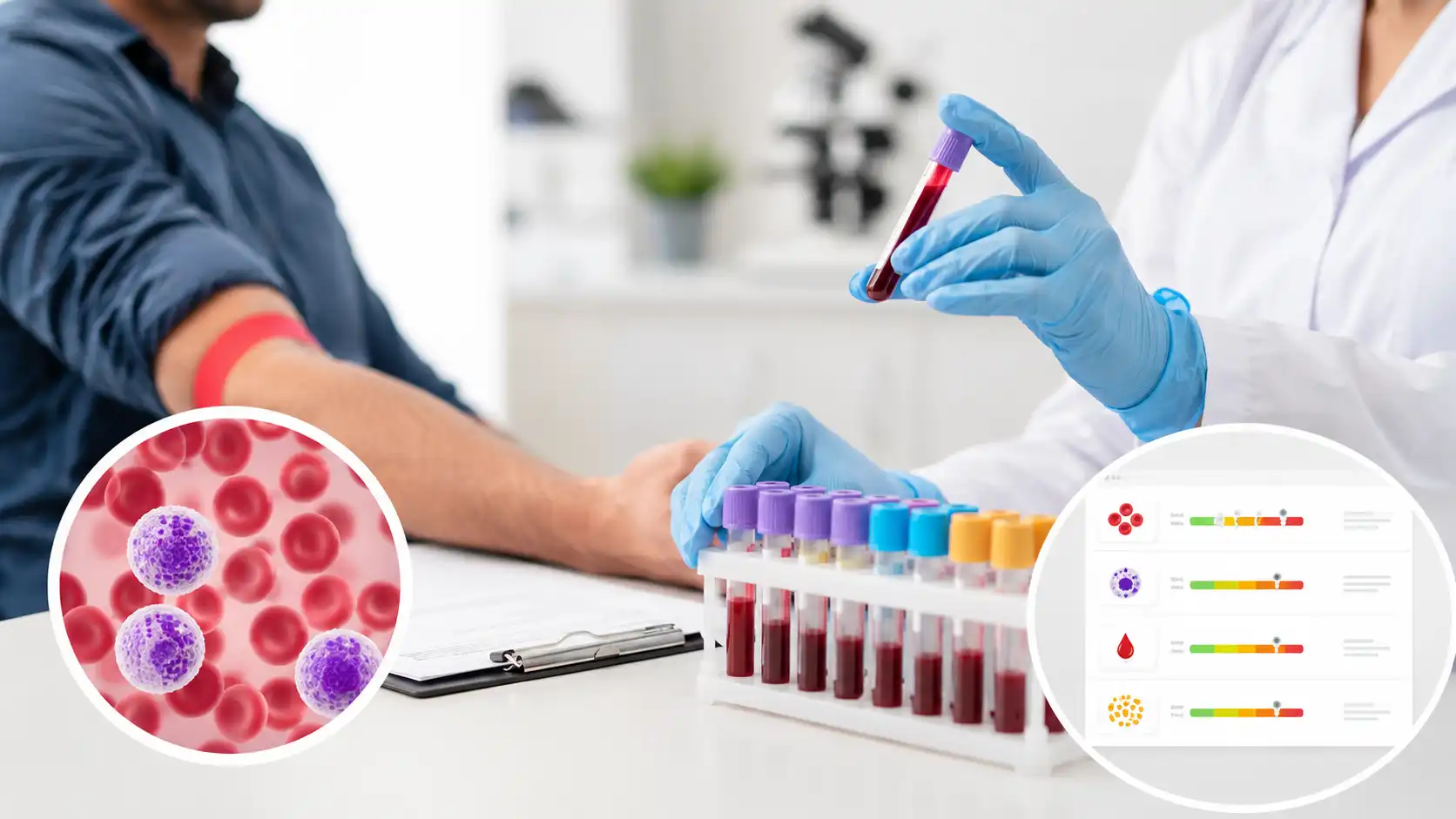
A complete blood count is the most ordered blood test in American medicine, and the least explained. Most patients leave with a portal result full of acronyms, a few red flags next to numbers they cannot interpret, and no context for what any of it means.
A CBC counts and measures the three cell types circulating in your blood: red cells that carry oxygen, white cells that fight infection, and platelets that clot. From those counts, a clinician can detect anemia, infection, inflammation, bleeding disorders, and early signs of blood cancers, usually before symptoms make the cause obvious.
What a CBC Measures, Component by Component
Reference ranges below reflect conventional US units for adults. Ranges vary by laboratory, analyzer, altitude, sex, pregnancy status, and age, so read your own report’s ranges rather than these.
| Component | Typical Adult Range | High May Suggest | Low May Suggest |
|---|---|---|---|
| White blood cells (WBC) | 4,500–11,000 /µL | Bacterial infection, inflammation, physical stress, steroid use, leukemia | Viral suppression, chemotherapy, marrow disorders, severe sepsis, autoimmune disease |
| Red blood cells (RBC) | Men 4.6–6.2, Women 4.2–5.4 million/µL | Dehydration, polycythemia, chronic hypoxia, smoking | Anemia, blood loss, nutritional deficiency |
| Hemoglobin (Hgb) | Men 13–18, Women 12–16 g/dL | Same as high RBC | The core anemia marker |
| Hematocrit (Hct) | Men 40–54%, Women 36–48% | Dehydration, polycythemia | Anemia, overhydration |
| MCV (average red cell size) | 80–100 fL | Macrocytic anemia: B12 or folate deficiency, alcohol use, hypothyroidism | Microcytic anemia: iron deficiency, thalassemia |
| MCH | 27–32 pg | Macrocytosis | Iron deficiency |
| MCHC | 32–36 g/dL | Spherocytosis, sample artifact | Iron deficiency |
| RDW (size variation) | ~11.5–15% | Early iron deficiency, mixed deficiencies, recent bleeding | Rarely clinically significant |
| Platelets | 150,000–400,000 /µL | Reactive thrombocytosis, iron deficiency, inflammation | Bleeding risk, marrow suppression, immune destruction |
| MPV (platelet size) | ~7.0–9.0 fL | Rapid platelet turnover | Underproduction in the marrow |
The Differential: Why “With Differential” Matters
A standard CBC counts white cells as one number. A CBC with differential splits that number into five types, and the pattern often points at the cause faster than the total count does.
| Cell Type | Typical Share | Elevated Pattern Often Reflects |
|---|---|---|
| Neutrophils | 40–60% (1,500–8,000 /µL) | Bacterial infection, tissue injury, steroids, physical stress |
| Lymphocytes | 20–40% (1,000–4,000 /µL) | Viral infection, mononucleosis, some chronic leukemias |
| Monocytes | 2–8% (200–1,000 /µL) | Chronic infection, recovery phase, inflammatory disease |
| Eosinophils | 0–4% (0–500 /µL) | Allergy, asthma, drug reaction, parasitic infection |
| Basophils | 0.5–1% (0–200 /µL) | Allergic reactions, rare myeloproliferative disorders |
A bacterial infection often produces neutrophilia with immature “band” forms, described on the report as a left shift. A viral infection more often shows lymphocytosis with a normal or low total WBC. These are patterns, not proof. A CBC alone cannot confirm bacterial versus viral, which is why clinicians pair it with the exam and targeted testing.
Our on-site lab services run the CBC during your visit rather than sending it out, which is what makes same-visit decisions possible.
Why Your Doctor Orders One
A CBC is ordered for four distinct reasons, and knowing which one applies to you changes how worried you should be.
Baseline screening. Part of a routine wellness exam or a pre-procedure workup. No symptom is being chased. Preventive visits and annual physicals commonly include one.
Symptom investigation. Fatigue, unexplained bruising, fever, shortness of breath, dizziness, recurring infections, or unintended weight loss.
Monitoring known conditions. Chronic kidney disease, thyroid and hormone disorders, autoimmune disease, and any medication that affects the marrow require serial counts. Patients managed through internal medicine often have a standing CBC interval.
Medication safety. Certain therapies require scheduled counts. Testosterone therapy is one clear example, since it can raise hematocrit into a range that requires dose adjustment.
Symptom-to-Marker Map
| What You Are Experiencing | Markers That Matter Most | What the Clinician Is Ruling Out |
|---|---|---|
| Persistent fatigue, pale skin, cold hands | Hgb, Hct, MCV, RDW | Iron deficiency vs B12/folate deficiency anemia |
| Recurrent fevers or infections | WBC with differential | Bacterial vs viral pattern, immune deficiency |
| Easy bruising, gum bleeding, heavy periods | Platelets, MPV, Hgb | Thrombocytopenia, blood loss anemia |
| Shortness of breath on exertion | Hgb, Hct, RBC | Anemia as a cause of exertional symptoms |
| Chronic itching, rash, or travel history | Eosinophils | Allergic response, drug reaction, parasitic infection |
| Unexplained weight loss with night sweats | WBC, differential, platelets, Hgb | Hematologic malignancy requiring urgent referral |
| Dizziness after vomiting or heat exposure | Hct, Hgb | Hemoconcentration from dehydration |
Dehydration deserves a note. Losing plasma volume concentrates the cells left behind, which pushes hematocrit and hemoglobin up without a single extra red cell being produced. In a North Texas July, that is a common and reversible finding.
Do You Need to Fast?
Not for a standalone CBC. Fasting is required only when the CBC is drawn alongside tests that fasting affects, such as a lipid panel or fasting glucose within a comprehensive metabolic panel.
Practical prep that does help: drink water beforehand, since well-hydrated veins are easier to draw and hemoconcentration skews results. Bring a current medication and supplement list, including iron, B12, and biotin. Wear a sleeve that pushes above the elbow.
CBC vs BMP vs CMP: Which Panel Answers Which Question
| Panel | What It Measures | Ordered To Assess | Fasting |
|---|---|---|---|
| CBC | Red cells, white cells, platelets | Anemia, infection, clotting capacity, marrow function | No |
| CBC with differential | The above plus 5-part white cell breakdown | Infection type, allergy, leukemia screening | No |
| BMP | 8 chemistries: electrolytes, glucose, kidney function | Hydration, kidney function, electrolyte balance, diabetes | Usually yes for glucose |
| CMP | BMP plus liver enzymes and proteins | The above plus liver function and nutritional status | Usually yes |
These are different tests, frequently drawn from the same visit. A CBC will not show your kidney function, your cholesterol, or your blood sugar. Patients tracking kidney disease or thyroid and adrenal conditions through endocrine care typically need chemistry panels alongside the CBC.

Reading a Result Without Panicking
A flagged lab value alone is not a clinical diagnosis. Standard reference ranges capture 95% of healthy individuals, meaning 5% of healthy patients naturally register values slightly outside normal parameters on any given marker.
What matters is the size of the deviation, the direction of change from your previous results, and whether multiple related markers move together.
Result Triage Guide
| Finding | Typical Urgency | What Usually Happens Next |
|---|---|---|
| One marker slightly outside range, no symptoms | Routine | Repeat in 4 to 8 weeks, or at your next visit |
| Mild anemia with low MCV | Routine to soon | Iron studies, diet review, source-of-loss evaluation |
| WBC modestly elevated with an obvious infection | Expected | Treat the infection, recheck after recovery |
| Hemoglobin below roughly 8 g/dL | Same week or sooner | Prompt evaluation for cause and severity |
| Platelets below roughly 50,000 /µL | Urgent | Same-day evaluation, bleeding precautions |
| WBC below ~1,500 or above ~30,000 /µL | Urgent | Same-day evaluation and likely referral |
| Blasts or immature cells reported on the smear | Urgent | Immediate hematology referral |
| Two or three cell lines low together | Urgent | Same-day evaluation for marrow disease |
These thresholds are general guides for adults, not personal medical advice. Your clinician interprets them against your history, medications, and prior results.
Cost, Access, and Turnaround in North Texas
Three practical factors decide whether a CBC actually gets done.
Turnaround. A clinic with an in-house hematology analyzer produces results in minutes to about an hour, inside the same visit. A send-out reference lab typically returns results in 24 to 72 hours, which means a second phone call, a second decision point, and sometimes a second appointment.
Distance. Patients in Gainesville, Valley View, and Lindsay who use a send-out lab often end up driving toward Denton or Sherman for a draw. Patients in Providence Village, Aubrey, Cross Roads, and Paloma Creek face the same problem in reverse during peak traffic.
Coverage. Most commercial plans and Medicare cover a CBC when it is medically indicated. Screening frequency limits and deductible status still apply, so confirm details on our insurance and payment page before your visit. Direct-to-consumer lab pricing exists but often excludes clinician interpretation, which is the part that turns numbers into a plan.
Same-visit labs also close the loop on treatment programs. Patients in a medical weight loss program or on hormone therapy need periodic counts, and running them during a regular visit prevents the missed-monitoring gap that derails those plans.
What to Ask Before You Leave the Clinic
- Which specific panels are being drawn today, and why?
- Will results come back during this visit or later?
- How will I receive results, and how fast?
- Which values will change my treatment, and which are being tracked over time?
- Should I repeat this, and when?
- Do any of my medications or supplements affect these numbers?
For a walk-through of how to interpret a lab report line by line, read our guide to decoding your lab results.
Absolute Urgent Care runs on-site labs at both locations, with primary care available through primary care in Gainesville and same-day access at urgent care in Providence Village. Call 940-301-5000 or 940-686-7500 to check availability.
This article is educational and does not replace evaluation by a licensed clinician. Discuss all lab results with your provider before acting on them.
Frequently Asked Questions
Do I need to fast for a CBC blood test?
No. Fasting is not required for a standalone complete blood count. It is required only when the CBC is drawn with tests such as a lipid panel or fasting glucose.
How long do CBC results take?
A clinic with an in-house analyzer typically produces results in minutes to about an hour during the same visit. Send-out reference labs generally take 24 to 72 hours.
Can a CBC detect cancer?
A CBC can raise suspicion for blood cancers such as leukemia through abnormal white cell counts, low platelets, anemia, or immature cells on the smear. It cannot diagnose cancer on its own and does not screen for most solid tumors.
What is the difference between a CBC and a CBC with differential?
A CBC reports total white blood cells. A CBC with differential breaks that total into neutrophils, lymphocytes, monocytes, eosinophils, and basophils, which helps distinguish infection types and allergic responses.
Does one abnormal CBC value mean something is wrong?
Not necessarily. Reference ranges are built around roughly 95% of a healthy population, so isolated mild flags are common. Trend, magnitude, and related markers matter more than a single flagged number.
Can I get a CBC without seeing a doctor?
Direct-to-consumer lab services exist in Texas, but they usually deliver numbers without clinical interpretation. A clinician-ordered CBC ties the result to your history and to a next step.