












“Five to ten days” is the answer most people find online. It is also the answer to the wrong question. Five to ten days is roughly when many stitches come out. It is not when the wound is healed.
Skin regains only about 80% of its original tensile strength, and it takes 11 to 14 weeks to get there. The stitches are the first two weeks of a process that runs closer to a year.
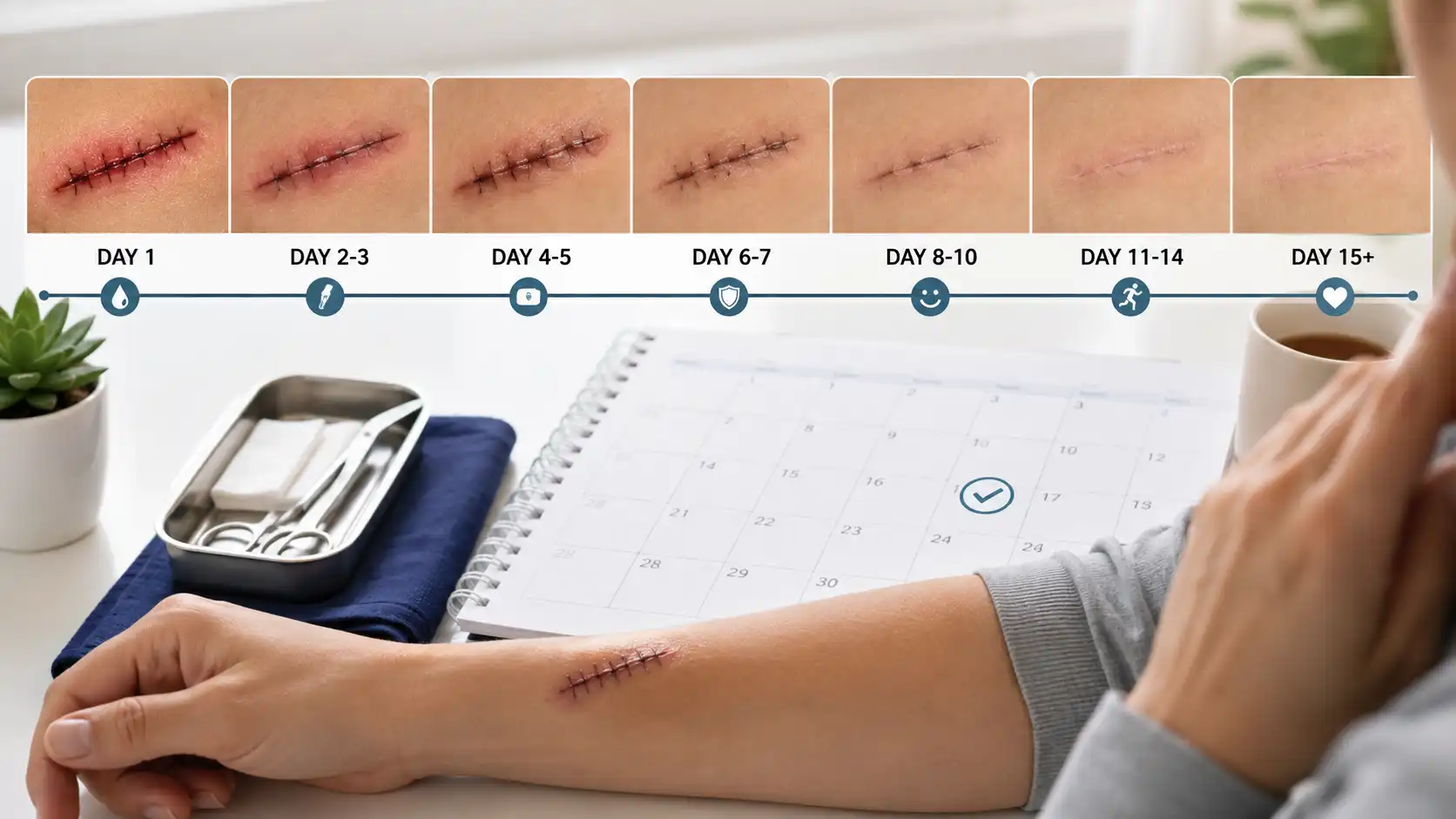
Here is what actually happens, day by day, and what you should be doing at each stage.
The Day-by-Day Healing Timeline
| Stage | What Is Happening Under the Skin | What You See | What You Do | Red Flags |
|---|---|---|---|---|
| Day 0–1 (Hemostasis) | Vessels constrict, platelets clot, fibrin seals the gap | Edges together, mild swelling, pinkness | Keep the dressing dry, elevate, ice over the dressing 15 min at a time | Bleeding that soaks through a dressing and does not stop with 10 minutes of pressure |
| Day 2–3 (Inflammatory) | Neutrophils and macrophages clear bacteria and debris | Redness at the edges, warmth, tenderness, clear-yellow drainage | Gentle cleansing per your provider’s instructions, dressing changes, acetaminophen or ibuprofen if appropriate for you | Redness spreading outward more than about 2 cm, throbbing pain that worsens after day 3 |
| Day 4–7 (Early proliferative) | Fibroblasts lay down collagen, new capillaries form, epithelium bridges the surface | Pink line, itching begins, swelling drops | Keep it clean and moisturized if instructed, no soaking, no swimming | Pus, foul odor, fever, red streaking toward the trunk |
| Day 8–14 (Removal window for most sites) | Collagen builds but strength is still low | Raised pink ridge, mild firmness | Stitch removal for most body areas, then support the scar with tape if advised | Wound edges separating after removal |
| Week 3–6 (Remodeling begins) | Type III collagen is replaced by stronger type I | Scar looks red or purple and may thicken | Begin sun protection and silicone gel or sheeting, gentle massage 1–2 minutes, 1–3 times a day | Rapid thickening, raised firm growth beyond the original margin |
| Month 2–6 | Collagen reorganizes along tension lines | Scar softens and flattens, color fades | Continue SPF 30+ and silicone daily | Persistent pain, numbness, or restricted movement |
| Month 6–18 | Final remodeling, strength plateaus near 80% | Scar becomes pale and flat | Maintain sun protection through the first year | New growth, ulceration, or color change |
Two practical points get lost in the standard advice. Itching around day 5 is a healing signal, not a warning, and scratching is the fastest way to reopen a wound. And the scar you have at week 4 is not the scar you will keep until your final appearance is judged at 12 to 18 months, not at one month.
When a Cut Still Can Be Stitched
The old “six to eight hours” rule has been overtaken. Current family medicine guidance describes primary closure of clean, non-infected wounds up to about 18 hours after injury, and up to about 24 hours for wounds on the head, where blood supply is richer.
Delay still matters. Bacterial load rises with every hour, and a wound closed late carries higher infection risk. Come in the same day. Our stitches care service handles laceration repair on a walk-in basis at both clinics.
Wounds that need evaluation regardless of appearance:
- Any cut that gapes open when the area is relaxed
- Bleeding that will not stop after 10 minutes of firm, continuous pressure
- Cuts over a joint, on the hand, on the face, or crossing the lip border
- Anything caused by glass, metal, or a mechanism that could leave debris in the wound
- Animal or human bites
- Numbness, weakness, or inability to move the area normally
- Cuts in patients with diabetes, immune suppression, or poor circulation
Deep wounds sometimes hide fractures or retained foreign bodies. On-site x-ray imaging settles that question during the same visit instead of a follow-up trip.
Suture Removal Schedule by Body Area
Removal timing is driven by tension and blood supply, not by how the wound looks to you. The face heals fast and scars badly if sutures stay too long. Palms and soles carry the most mechanical load and need the longest.
| Body Area | Typical Removal | Why | Activity Restriction |
|---|---|---|---|
| Face | 3–5 days | Excellent blood supply; longer stays leave track marks | Avoid facial expression extremes, no makeup over the line |
| Scalp | 7–10 days | Good supply, moderate tension | Gentle washing, no vigorous scrubbing |
| Arms | 7–10 days | Moderate tension | Limit lifting on that side |
| Trunk / back | 10–14 days | High tension, slower healing | No heavy lifting or twisting |
| Legs | 10–14 days | Gravity, swelling, movement | Limit stairs and prolonged standing |
| Hands and feet | 10–14 days | Constant motion | Avoid gripping, wear protective footwear |
| Over a joint | ~14 days | Repeated stretch stress | Splinting may be advised |
| Palms and soles | 14–21 days | Thickest skin, maximum load | Restrict weight bearing or gripping |
Sources conflict slightly on arms, where some references list 10 to 14 days. Your provider adjusts for wound tension, location, and your healing risk factors, so follow the date you are given rather than a general table.
Do not attempt self-removal of sutures. Premature self-removal causes wound dehiscence leaving a wide scar while late removal creates permanent suture track marks. Removal is quick, usually painless, and available as a walk-in at urgent care in Providence Village even if the original repair was done elsewhere.
Which Closure Method You Get, and Why
Stitches are one of four options. The choice depends on tension, location, contamination, and cosmetic priority.
| Method | Best For | Removal Needed | Wetting Rules | Cosmetic Result |
|---|---|---|---|---|
| Non-absorbable sutures (nylon, polypropylene) | Most skin lacerations, high-tension areas | Yes, per the schedule above | Keep dry 24–48 hours, then per instructions | Excellent when removed on time |
| Absorbable sutures (fast gut, Vicryl Rapide, Monocryl) | Children, mucosa, deep layers, patients unlikely to return | No | Same early rules | Comparable to non-absorbable for cosmesis, infection, and dehiscence |
| Skin adhesive (Dermabond) | Clean, low-tension, straight cuts away from joints | No, sloughs off in 5–10 days | No soaking, no ointments on the film | Very good for the right wound |
| Staples | Scalp, some trunk wounds, fast closure needed | Yes | Similar to sutures | Poorer than sutures |
| Adhesive strips (Steri-Strips) | Very superficial, low-tension cuts, post-suture support | No, allow to fall off | Keep dry | Good for shallow wounds |
Absorbable suture dissolution varies by material: fast-absorbing gut breaks down in roughly a week, plain gut in 10 to 14 days, chromic gut around three weeks, and synthetics such as Vicryl and Monocryl over 60 to 120 days. Deep sutures you never see may still be dissolving months later, which is normal.
Ointments and adhesives do not mix. Antibiotic ointment can dissolve skin adhesive early, so use it only if your provider tells you to.
Infection, Tetanus, and the Rules That Actually Change Outcomes
Infection risk peaks between days 2 and 7. The distinction that matters is between expected inflammation and spreading infection.
Expected: mild redness right at the wound edge, mild warmth, clear or slightly yellow drainage in the first 48 hours, tenderness that improves daily.
Get evaluated the same day for: redness expanding outward, pain increasing after day 3, thick or foul-smelling pus, fever or chills, red streaks running toward the body’s center, wound edges pulling apart, or new numbness.
Tetanus is the step patients skip. For clean minor wounds, a booster is indicated if it has been 10 or more years since the last dose. For all other wounds, including anything dirty, puncturing, or caused by metal, the interval drops to 5 years. If your vaccination history is unknown or incomplete, tell the provider so tetanus immune globulin can be considered for higher-risk wounds.
Wounds that arrive contaminated or already inflamed may need more than closure. Our surgical services cover abscess drainage, foreign body removal, and wound exploration, and our team also manages related skin conditions that complicate healing, such as cellulitis or eczema at the wound margin.
Living With Stitches: Practical Rules
- Showering. Most patients can shower after the first 24 to 48 hours, letting water run over the area without scrubbing, then patting dry. Evidence suggests early uncovering for bathing does not raise infection risk, but your provider’s instructions override the general rule.
- Soaking. No baths, pools, hot tubs, lakes, or stock tanks until the wound is fully closed and cleared. This matters in North Texas summers, and it is the single most common reason a clean repair turns into an infection.
- Work. Manual labor, gripping, and repeated bending across the wound are what pull stitches apart. If your job requires them, ask for a work restriction note at the repair visit rather than after a problem develops. Employers in Cooke and Denton counties can route injured workers through our occupational medicine program, which covers injury care, restrictions, and return-to-work documentation.
- Exercise. Walking is usually fine early. Sweat, friction, and stretching are the problem. Most patients wait until after removal for anything strenuous, longer for wounds over joints.
- Sun. New scars pigment permanently if they burn. SPF 30 or higher over the scar for a full 12 months is the cheapest cosmetic intervention available.
- Itching. Keep the area moisturized if instructed, use a cold pack over the dressing, and do not scratch. Sudden intense itching with a spreading rash may be an adhesive or ointment allergy and should be evaluated.
What the Visit Costs You in Time
Laceration repair is a same-visit procedure. Evaluation, anesthesia, cleaning and irrigation, closure, tetanus update if needed, and wound care instructions typically fit inside one urgent care visit, with x-ray added when a foreign body or fracture is suspected.
Gainesville patients can walk in at 800 W Highway 82 seven days a week, and Providence Village patients at 26631 US HWY 380E, Suite A, Monday through Friday. Both offer online check-in, which reduces the time spent sitting in the waiting room with a wound.
For a broader look at wound management after minor injuries, read how stitches care supports healing after minor injuries, and review the full range of urgent care services in Gainesville before you arrive.
This article is educational and does not replace evaluation by a licensed clinician. Call 911 for uncontrolled bleeding, deep puncture wounds to the chest or abdomen, or suspected arterial injury.
Frequently Asked Questions
How long do stitches take to heal completely?
Stitches usually come out in 3 to 14 days depending on body area, but the wound continues remodeling for 12 to 18 months and reaches only about 80% of original skin strength at roughly 11 to 14 weeks.
Can I get my stitches wet?
Most patients can shower after 24 to 48 hours without scrubbing the area. Soaking in baths, pools, or hot tubs must wait until the wound is fully closed and cleared by your provider.
Why are my stitches itchy?
Itching around days 4 to 7 usually reflects new tissue and nerve regeneration during the proliferative phase. Scratching risks reopening the wound. Spreading rash or intense itching may indicate a reaction and needs evaluation.
What happens if stitches are left in too long?
Sutures left beyond the recommended window can leave permanent track marks and raise infection risk. Removal that is too early risks the wound splitting open. Follow the removal date you were given.
How do I know if my stitches are infected?
Warning signs include expanding redness, increasing pain after day 3, thick or foul-smelling drainage, fever, red streaking, or separating wound edges. Any of these warrant same-day evaluation.
Do dissolvable stitches need removal?
No. Fast-absorbing gut dissolves in about a week, plain gut in 10 to 14 days, and synthetic absorbables over 60 to 120 days. Deep sutures may take months and are never removed.